How Matcha Confectionery Gets Made
Drinking and baking ask different things of the same ingredient.
Colour is the main asset
Green food ingredients are scarce. Matcha delivers green without colouring agents, which is difficult to substitute.
Carrying both flavour and colour is why it appears so widely.
But it is heat-sensitive
Matcha's green comes from chlorophyll, which degrades under heat toward a yellowish cast.
Holding green through baking is difficult and requires attention to temperature and time. Cold applications retain it more easily.
Unbaked applications
Ice cream and gelato Colour and flavour both survive. Dairy fat wraps bitterness, so higher matcha loads stay drinkable.
Mousse and bavarois Gelatin means minimal heat. Dissolve below 80°C and the effect on colour is limited.
Kanten and jelly Kanten requires a full boil. Dissolve the agar first, remove from heat, then stir in the matcha — that sequence preserves colour.
Baked applications
Cakes, cookies, bread Oven heat shifts the colour. Options: increase the matcha to compensate, or dust the surface after baking.
Chocolate Tempering runs at relatively low temperature, so colour holds. Cocoa butter softens the bitterness.
Baking grade exists
Products formulated for heat stability and colour development. Tasted straight, they can read bitter.
Conversely, drinking-grade matcha in a baked good loses aroma and shifts colour. Higher price does not translate into a better result across applications.
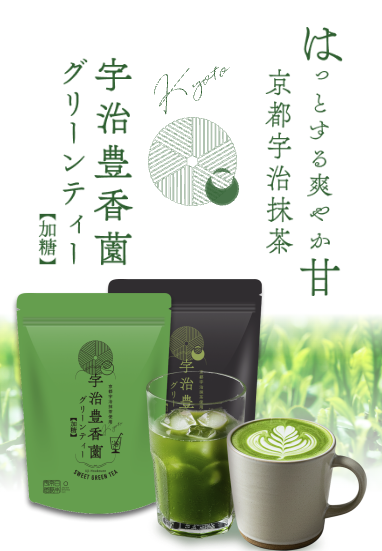
Using sweetened powder
Sugar is already present, so recipe sugar needs reducing.
It is also convenient. Stirred into yogurt, set into a milk jelly, poured over ice cream — as a sweet liquid, no sugar calculation.
Never add it dry
Dry powder leaves specks that will not mix out. Dissolve in a little liquid first, exactly as for a drink.