Catechins in Matcha: Why It Tastes Milder Than You Might Expect
The astringency you notice in tea comes from catechins, a type of polyphenol. They make up roughly 8 to 20 percent of the dry weight of tea leaves.
Yet sweetened matcha rarely tastes harsh. Same plant, very different experience. The explanation starts in the field, not the cup.
Catechin is not one compound
The word covers several related compounds. In brewed green tea, the proportions fall roughly like this:
| Compound | Share |
|---|---|
| Epigallocatechin gallate (EGCG) | about 59% |
| Epigallocatechin (EGC) | about 19% |
| Epicatechin gallate (ECG) | about 14% |
| Epicatechin (EC) | about 6% |
EGCG, the most abundant, is also among the more astringent. So the balance matters as much as the total.
Sunlight turns umami into astringency
Here is the part that explains matcha.
The savory quality in tea comes from L-theanine, an amino acid. It forms in the roots and travels up to the leaves. When those leaves are exposed to sunlight, theanine converts into catechins — the astringent compounds.
Theanine and catechins are not unrelated. Sunlight sits between them. Expose the plant and it turns sharper. Shade it and the savory character stays.
Growers shade the plants on purpose
That is what oishita saibai, or shaded cultivation, is for. Covers go over the tea field while the new shoots are developing, blocking sunlight and slowing the conversion.
In Uji, near Kyoto, this method has been used for centuries to produce tencha — the leaf that becomes matcha — and gyokuro. From April into May, the covers make the bushes disappear from view entirely.
Tencha is steamed, dried without rolling, then stripped of stems and veins. Stone-milling that leaf produces matcha.
So the mildness is not a processing trick. The astringency was kept low from the growing stage onward.
Sugar softens it further
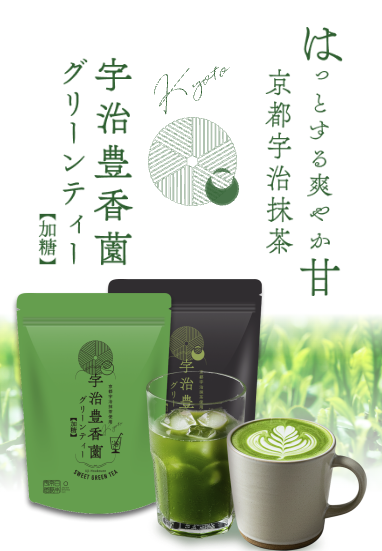
Most powdered products sold as sweetened matcha combine matcha with sugar. Sweetness suppresses the perception of astringency, which is why these taste gentler than straight matcha.
How much gentler depends on the blend. Ingredient lists are ordered by weight, so whether matcha or sugar comes first tells you a good deal. Some products include dextrin and flavoring; others contain only matcha and sugar.
You control the strength
Powder gives you a dial that bottled drinks do not.
- Cold: 20 g per 150 ml water
- Hot: 20 g per 150 ml hot water
- With milk: 18 g per 150 ml milk
Use less if astringency bothers you, more if you want the tea to come forward. Milk softens it the most, since the fat coats the palate.
One practical note
Because matcha is the whole leaf ground into powder, you consume components that never make it into a steeped cup. Japan's Standard Tables of Food Composition lists matcha at 2,900 μg of vitamin K and 1,200 μg of folate per 100 g.
Sweetened versions contain less matcha by weight, so those figures do not transfer directly. Still, if you take prescription medication, it is worth mentioning to your doctor or pharmacist before making it a daily habit.