What the Market Is Actually Valuing
Export figures show volume rising and unit prices rising faster. Worth asking what is being paid for.
The numbers
Japan's 2025 green tea exports: roughly ¥72.1 billion in value, close to double the previous year, on 12,612 tonnes, about 1.4 times.
Value grew faster than volume. The same weight sells for more.
US-bound shipments carry a unit price roughly five times that of Chinese green tea. This is not price competition.
Origin as a signal
Among the factors cited for rising unit prices is the penetration of the Uji/Kyoto origin brand.
A place name serving as a quality indicator — structurally similar to wine appellations.
What supports it
Cultivation method Shaded cultivation, blocking sunlight so L-theanine does not convert into astringent catechins. Labor and materials intensive.
Cultivars Selected around Uji for their response to shading — Samidori, Asahi, Gokou.
Processing Dried without rolling, stems and veins removed, stone-milled slowly. The mill produces roughly 40 g per hour.
Measurable composition NARO research reports higher theanine content in higher-priced matcha, with a distinguishable EGCG-to-EGC ratio. The impression has analytical backing.
Scarcity is part of the value
None of these scale quickly with demand.
Tea plants take years. Shading requires people. Stone mills cannot be sped up. Those constraints are exactly what produces scarcity.
Established at the premium end
Expanding presence in high-end restaurants and specialty retail is also cited.
The positioning is as a material evaluated on quality, not as an inexpensive commodity.
Where sweetened matcha fits
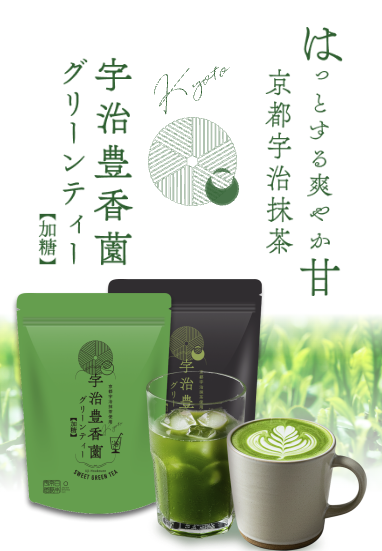
In this context, it functions as an entry point.
Plain matcha is bitter and requires equipment. Something that dissolves in water is the first step toward it.
Figures reflect statistics as of 2025.